According to updated data from the General Statistics Office, total registered foreign investment into Vietnam in the first five months of 2024 (as of May 20, 2024), including newly registered capital, adjusted capital, and the value of capital contributions and share purchases by foreign investors, reached nearly $11.07 billion, a 2% increase compared to the same period last year. This is a modest increase but much more positive compared to the 7.3% decline in the first five months of 2023 and the 16.4% decline in the first five months of 2022.
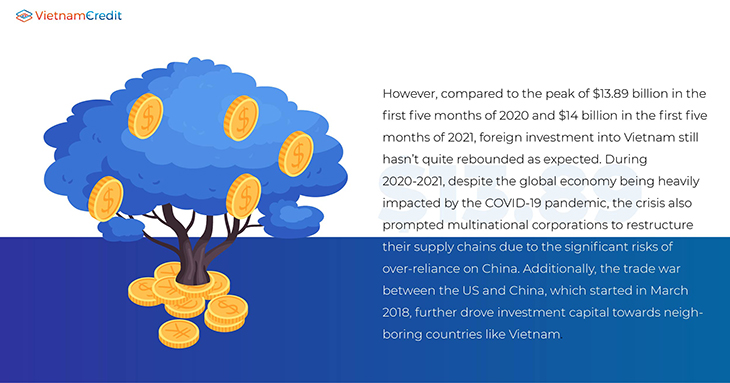
However, compared to the peak of $13.89 billion in the first five months of 2020 and $14 billion in the first five months of 2021, foreign investment into Vietnam still hasn’t quite rebounded as expected. During 2020-2021, despite the global economy being heavily impacted by the COVID-19 pandemic, the crisis also prompted multinational corporations to restructure their supply chains due to the significant risks of over-reliance on China. Additionally, the trade war between the US and China, which started in March 2018, further drove investment capital towards neighboring countries like Vietnam.
Recently, in mid-May 2024, the US unexpectedly announced a significant increase in tariffs on many imports from China, from electric vehicles, batteries, medical equipment to aluminum and steel products. This move could potentially lead to a similar effect, with direct foreign investment (FDI) continuing to shift from China to Vietnam more strongly in the coming period, especially as Vietnam has recently elevated its partnerships to strategic comprehensive levels with major countries like the US, Japan, and Australia, while Western economies and China are tending to decouple.
In fact, a more detailed assessment of foreign investment in the first five months of 2024 shows that newly registered FDI capital grew strongly, with 1,227 projects licensed with registered capital reaching $7.94 billion, up 27.5% in the number of projects and a sharp increase of 50.8% in registered capital compared to the same period last year. This indicates that international investors still highly value Vietnam’s growth prospects in the coming years, and the global minimum tax policies applied in Vietnam from early 2024 do not seem to have had a significant negative impact as previously feared.
Among the 53 countries and territories with newly licensed investment projects in Vietnam in the first five months of 2024, Singapore was the largest investor with $2.92 billion, accounting for 36.8% of total newly registered capital; capital from China, including Hong Kong, reached over $1.88 billion, accounting for 23.8%; Japan ranked third with $947.7 million, accounting for 11.9%.
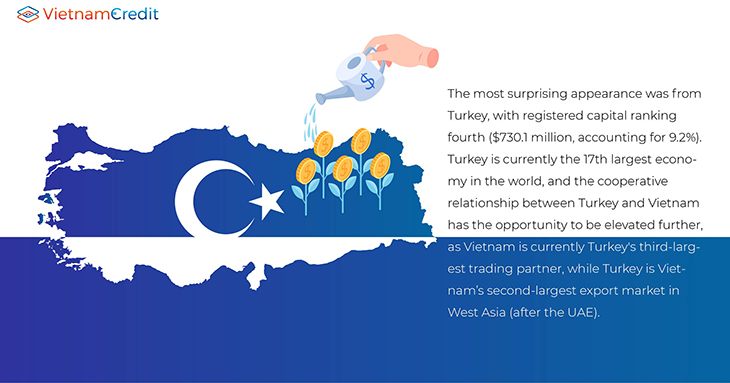
The most surprising appearance was from Turkey, with registered capital ranking fourth ($730.1 million, accounting for 9.2%). Turkey is currently the 17th largest economy in the world, and the cooperative relationship between Turkey and Vietnam has the opportunity to be elevated further, as Vietnam is currently Turkey's third-largest trading partner, while Turkey is Vietnam’s second-largest export market in West Asia (after the UAE).
In the first five months of 2024, while newly registered FDI capital grew impressively, adjusted FDI capital recorded a decrease of 8.7% compared to the same period last year, down to $2.08 billion. Compared to $5.61 billion in the first five months of 2022 and $3.86 billion and $3.46 billion in the first five months of 2021 and 2020 respectively, adjusted capital has shown a negative downward trend.
The decrease in adjusted capital reflects changes in the investment strategies of foreign investors, possibly due to high-interest rates in many countries as they continue to pursue tight monetary policies, making investment borrowing costs too high. Additionally, Vietnam's investment environment still has certain limitations, from bottlenecks in infrastructure and logistics to increasing energy shortage risks, which may have influenced the decision of multinational corporations to expand investment in Vietnam.
Similarly, indirect investment capital is also showing a less positive trend. In the first five months of 2024, there were 1,158 capital contributions and share purchases by foreign investors, with a total value of $1.05 billion, a significant decrease of 68.2% compared to the same period last year. Among these, there were 427 capital contributions and share purchases that increased the charter capital of enterprises with a capital contribution value of $580.7 million; 731 foreign investors bought back shares domestically without increasing charter capital with a value of $472.6 million.
Notably, if in previous years indirect investment capital often focused on manufacturing and processing industries and financial banking sectors, in the first five months of this year, capital contributions and share purchases were recorded in professional, scientific, and technological activities, reaching $253.3 million, accounting for 24.1%. This somewhat indicates that Vietnam is still striving to attract and call for investment in selective fields, prioritizing projects with high intellectual content.
The weakening trend of indirect investment capital is also reflected in the continuous net selling actions of foreign investors in the stock market in recent years. Statistics show that in May alone, foreign investors net sold nearly VND 15.7 trillion on the HOSE, despite the VN-Index continuing to recover positively. In the first five months of 2024, foreign investors net sold more than VND 35.3 trillion on the HOSE, exceeding the net selling figure for the entire year of 2023.
Exchange rate risks are also likely to be one of the factors affecting adjusted FDI capital and indirect investment capital from the beginning of the year. In just the past five months, the Vietnamese dong has depreciated nearly 5% against the US dollar, higher than the devaluation rate for the entire year of 2023. Notably, the USD/VND exchange rate is still under pressure from the continued strengthening of the US dollar in the international market and the decline of many currencies in the region, such as the Japanese yen and the Chinese yuan.
Nevertheless, the positive point is that exchange rate risks do not seem to have much impact on FDI disbursement in recent times. Specifically, the first five months of this year saw implemented FDI in Vietnam estimated at $8.25 billion, an increase of 7.8% compared to the same period last year, marking the highest level for the first five months over the past five years.
Source: thesaigontimes
Compiled by VietnamCredit